Could Occasionally Cutting Carbs Make You Faster?
Plus: Carbon shoes improve efficiency; when (and why) cardiac deaths occur; sleep and injury risk; money as a performance enhancer; and high-volume training and atherosclerosis.


Periodizing Carbohydrate Intake Makes Runners More Efficient
Even though most of us know that carbohydrates are king when it comes to endurance performance, the idea that cutting carbs to become a better fat burner, in the hopes of improving endurance, has still stuck around. But the science question underneath the hype is legit: if you deliberately cycle carbs across a training block—low during base training, higher during intensity—could you actually change physiology in a way that matters for running?
A new study tested that idea in a pretty straightforward way. Twenty-four recreationally active male runners (average VO₂ peak of 51) were randomized into one of three diet strategies during an 8-week endurance training block that was split into two phases: 4 weeks of endurance-focused training and 4 weeks emphasizing higher-intensity intervals. The diets were:
PER (periodized): 4 weeks very low carb (≤50 g/day), then 4 weeks high carb
Low-carb, high-fat (LCHF): 8 weeks very low carb (≤50 g/day)
Carbohydrates (CHO): 8 weeks higher carb (the comparison group)
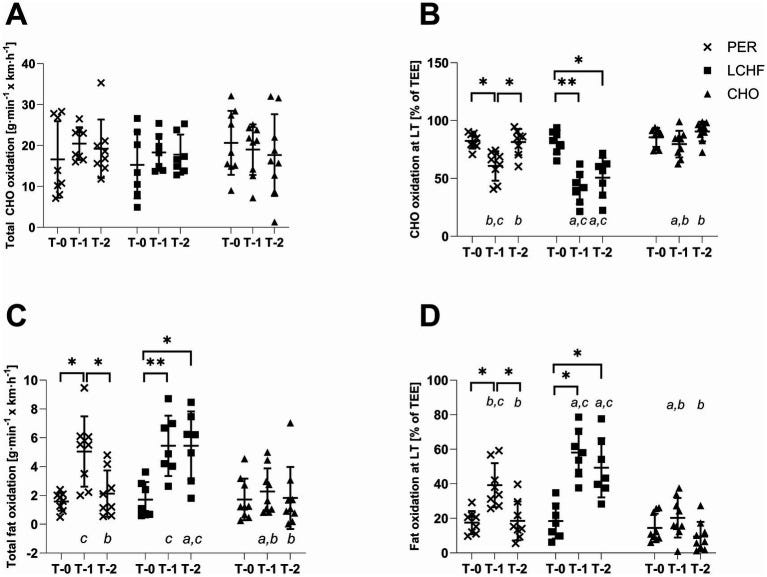
Everyone followed the same running program of five sessions per week. Testing occurred at baseline, after week 4, and after week 8. The key lab test was a graded treadmill protocol with gas exchange and lactate sampling, so the researchers could quantify peak running speed, time to exhaustion, running economy (oxygen cost), and shifts in substrate use (fat vs carbohydrate oxidation), including at the lactate threshold.
Performance markers improved over time across the board. Peak running speed increased significantly from week 0 to week 4 and again from week 4 to week 8. Time to exhaustion also improved (+55 seconds from week 0 to week 4 and +42 seconds from week 4 to week 8). But these gains were not meaningfully different between diet groups. Everyone got fitter, and the diet strategy didn’t separate the groups.
Where the diets did separate was in metabolism.
The low-carb phases pushed the runners toward higher fat use. Both PER and LCHF increased total fat oxidation in the first 4 weeks, and the LCHF group maintained that pattern through week 8. The periodized group is the best demonstration of the concept: once they reintroduced carbs in the second half, the substrate shift reversed—carb oxidation rose, and fat oxidation dropped back toward baseline patterns. The same “up then down” pattern showed up in maximal fat oxidation—PER increased their max fat oxidation during the low-carb phase, then decreased once carbs returned, while LCHF increased and stayed elevated. That’s metabolic flexibility in the most literal sense, and it’s changeable in a matter of weeks.
Running economy at lactate threshold showed a significant change between groups. In PER, oxygen cost at lactate threshold decreased (improved) from baseline to the end of the intervention, while the other groups didn’t show a consistent improvement across the same timepoints.
What this means for runners
A strategic low-carb block can push your fat oxidation up, and reintroducing carbs restores carbohydrate use—so you’re not permanently “stuck” in one metabolic mode. But don’t expect carb cycling to be a performance cheat code. In this study, peak speed and time-to-exhaustion improved similarly, no matter what people ate. The intriguing piece is running economy improving in the periodized group, which suggests that if you like lower-carb during easier base weeks (sometimes for appetite control or body composition), it can have benefits, but you probably want carbs back on board when the work turns into intervals, because that’s when glycolytic capacity matters and when you’re most likely to pay a price for chronically low glycogen.
Carbon-Plated Shoes Improve Running Economy
The consensus on carbon-plated shoes is clear: they make you faster. The mechanism is… less clear. But the leading theory is that they reduce the “energetic cost” of running, essentially making runners more efficient at the same speed.
A new systematic review and meta-analysis investigated whether, when you compare carbon-plated shoes to non-plated shoes, you reliably see lower metabolic demand during running, and how big is the effect?
Researchers included 14 studies comparing plated vs non-plated running shoes in healthy adults. In all of the studies, each participant ran in both shoe conditions, which helps control for the enormous between-runner variability in economy with “supershoes.”
They focused on a few metabolic outcomes that are essentially different ways of asking the same question (“how expensive is it to run at a given pace?”):
Running economy (mL·kg⁻¹·km⁻¹)
Metabolic cost (W·kg⁻¹)
Oxygen consumption (mL·kg⁻¹·min⁻¹)
Energetic cost of transport (ECOT; J·kg⁻¹·m⁻¹)
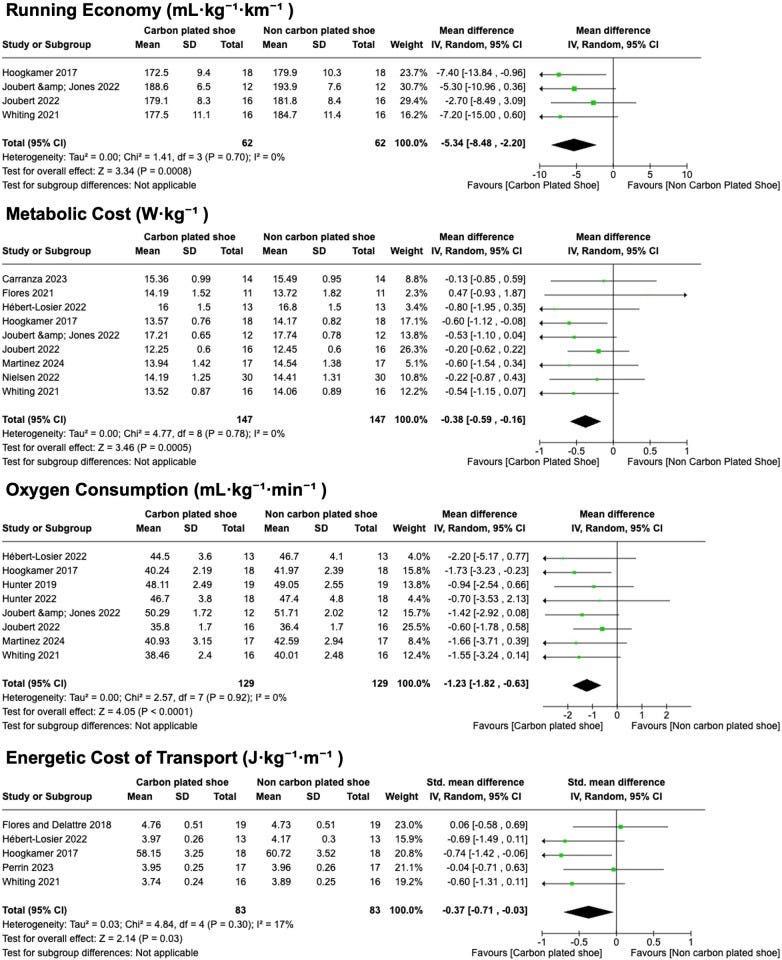
On average, carbon-plated shoes lowered metabolic demand across the board. The estimates favored plated shoes for running economy (a 5.34 mL·kg⁻¹·km⁻¹ advantage), metabolic cost (0.38 W·kg⁻¹ advantage), oxygen consumption (a 1.23 mL·kg⁻¹·min⁻¹ advantage), and ECOT (a 0.37 J·kg⁻¹·m⁻¹ advantage).
The authors also translated the pooled effects into something a bit more intuitive: plated footwear lowered metabolic demand by ~2–3% (average −2.75%, with a range from about −1% to −4.5% depending on the specific outcome and study).
That magnitude matches what most runners “feel” in super shoes. It’s not a night-and-day transformation, but a meaningful edge, especially as pace increases and races get longer.
What this means for runners
If you’re deciding whether carbon-plated shoes are “worth it,” the scientific answer is yes: across controlled crossover studies, plated shoes are associated with about a 2–3% reduction in metabolic cost during submaximal running.
When (and Why) Cardiac Deaths Happen During Races
The finish line is where ego, adrenaline, and physiology all collide. And it’s also where the risk of sudden cardiac arrest (SCA) spikes.
A new study uses a decade-plus of prospective data from Paris to answer when sudden cardiac arrest happens during big endurance races, what it looks like, who it happens to, where in the race it happens, and whether we know why it happens.
Researchers combined two data sources. First, the Paris Sudden Death Expertise Centre registry (SDEC), which prospectively tracks out-of-hospital cardiac arrest across a population of ~6.7 million people. Second, they pulled participation and timing data from official race results for the Paris 20 km, the Paris Half Marathon, and the Paris Marathon from 2011–2024 (excluding 2020). They then identified race-related SCA cases (adults, occurring on race day within a defined time window, and not clearly due to a non-medical cause), verified where on the course each arrest occurred, and linked that to participation numbers to calculate incidence.
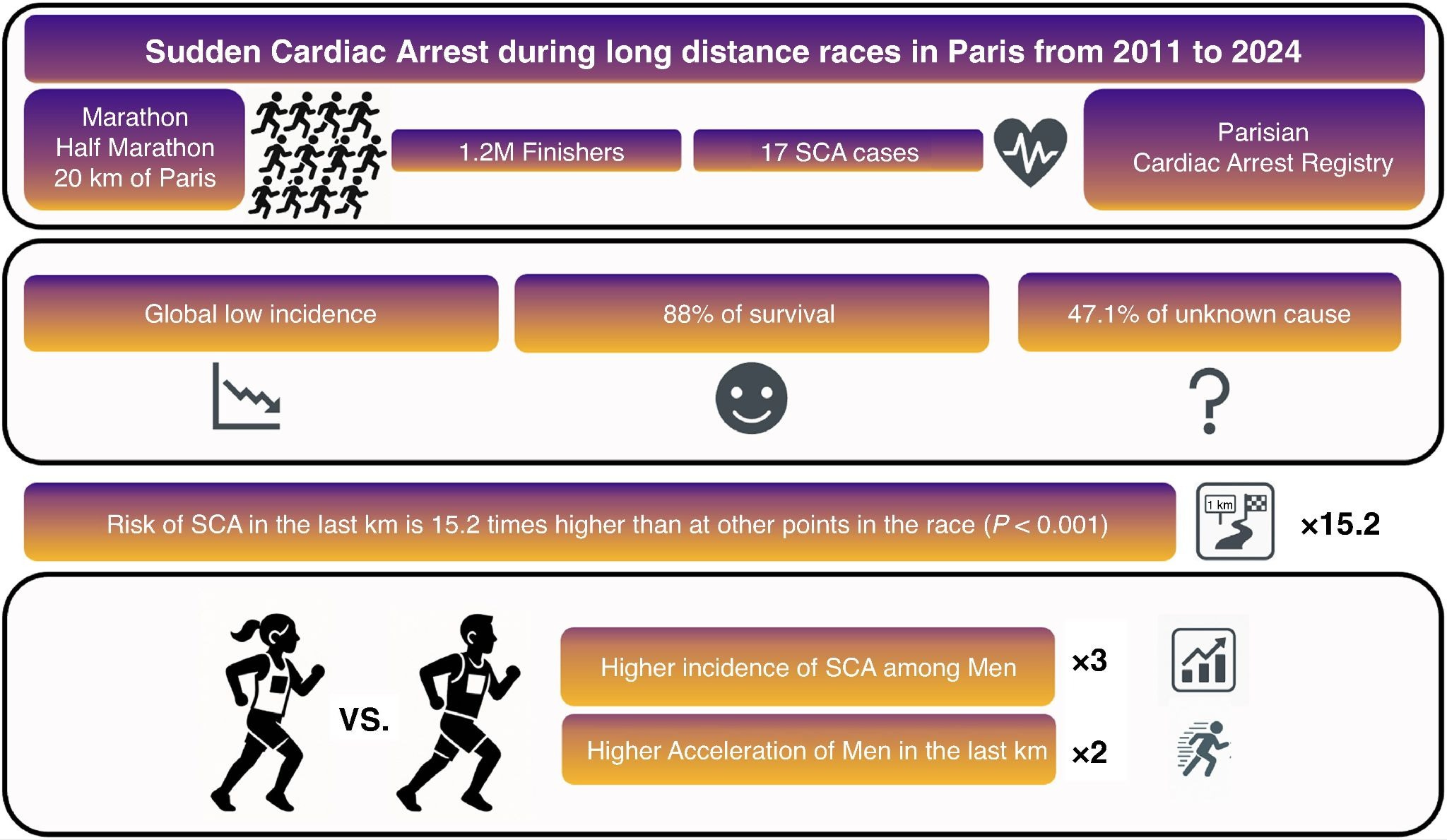
Across about 1.2 million participations, there were 17 sudden cardiac arrests during these three events. The absolute risk is low. When they broke it down by sex, the incidence was 16.9 per million participations in men and 5.7 per million in women—so men were overrepresented (and 15 of the 17 cases were male). The average age of cases was 42 years.
The second big takeaway is the “where.” In the 20 km race, 6 of 7 arrests occurred in the final kilometer. In the half-marathon, 3 of 5 occurred in the final kilometer (with two additional arrests happening just before that). In the marathon, this clustering pattern didn’t hold: only 1 of 5 arrests happened in the last kilometer. The risk of an SCA in the final kilometer of the shorter races was 15.2 times higher than at other points on the course.
On the reassuring side, outcomes were excellent: 88% survived (15/17), and survivors had excellent neurological status at discharge.
On the unsettling side: even with extensive in-hospital evaluation, the cause was often unclear. They identified a specific cause in just 9 of 17 cases. The most common known cause was ischemic cardiomyopathy (5 cases). There were also isolated diagnoses like Brugada syndrome, myocarditis, and an anomalous right coronary artery. But in 8 of 17 cases (47.1%), no cause was found—despite workups that included advanced imaging and other testing.
Finally is the behavioral/performance angle: among 323,028 half-marathon finishers, most people sped up at the end (87% showed some acceleration). But men were more likely to make a surge, and compared to women, men were nearly twice as likely to accelerate in the final kilometer. That sex gap in end-of-race acceleration widened with age.
Putting it together, the finish-line clustering plus the male-specific surge pattern points toward a plausible mechanism: the final kilometer is a unique physiological stress test where maximal sympathetic drive, higher mechanical and metabolic strain, and more abrupt intensity change occur. Some runners (more often men) seem more likely to spike that demand right at the end, and this could raise the risk of a cardiac event.
What this means for runners
The conclusion here isn’t that races are dangerous, because the incidence here is genuinely low. Rather, the finish line is a distinct risk window where intensity often jumps abruptly, especially for men. If you’re a middle-aged runner with cardiovascular risk factors (or you’re the type who goes from controlled effort to an all-out sprint the moment you see the clock), this is a reminder to heed caution. Zooming out, the 88% survival rate is an argument for racing in well-supported events, because fast recognition, fast CPR, and fast defibrillation seem to be making a difference in outcomes.