Do supershoes help women more?
Advanced footwear technology has changed road racing, but the benefits may not have been evenly distributed.
In this study, researchers compared elite performances from a pre-supershoe era (2009–2015) with an advanced-footwear era (2017–2024). For each sex, event, and era, they collected the top 50 performances in the road 10K, half marathon, and marathon. Each athlete contributed only one performance per event and era, which prevented a single superstar (or “super responder”) from flooding the data set.
The clever part was the control group. Instead of simply asking whether road times got faster, the researchers also examined the top 50 performances in four throwing events: shot put, discus, javelin, and hammer. Throwers benefited from many of the same era-wide changes as runners—better training, sports science, recovery, nutrition, talent development, and competition—but not from carbon-plated racing shoes.
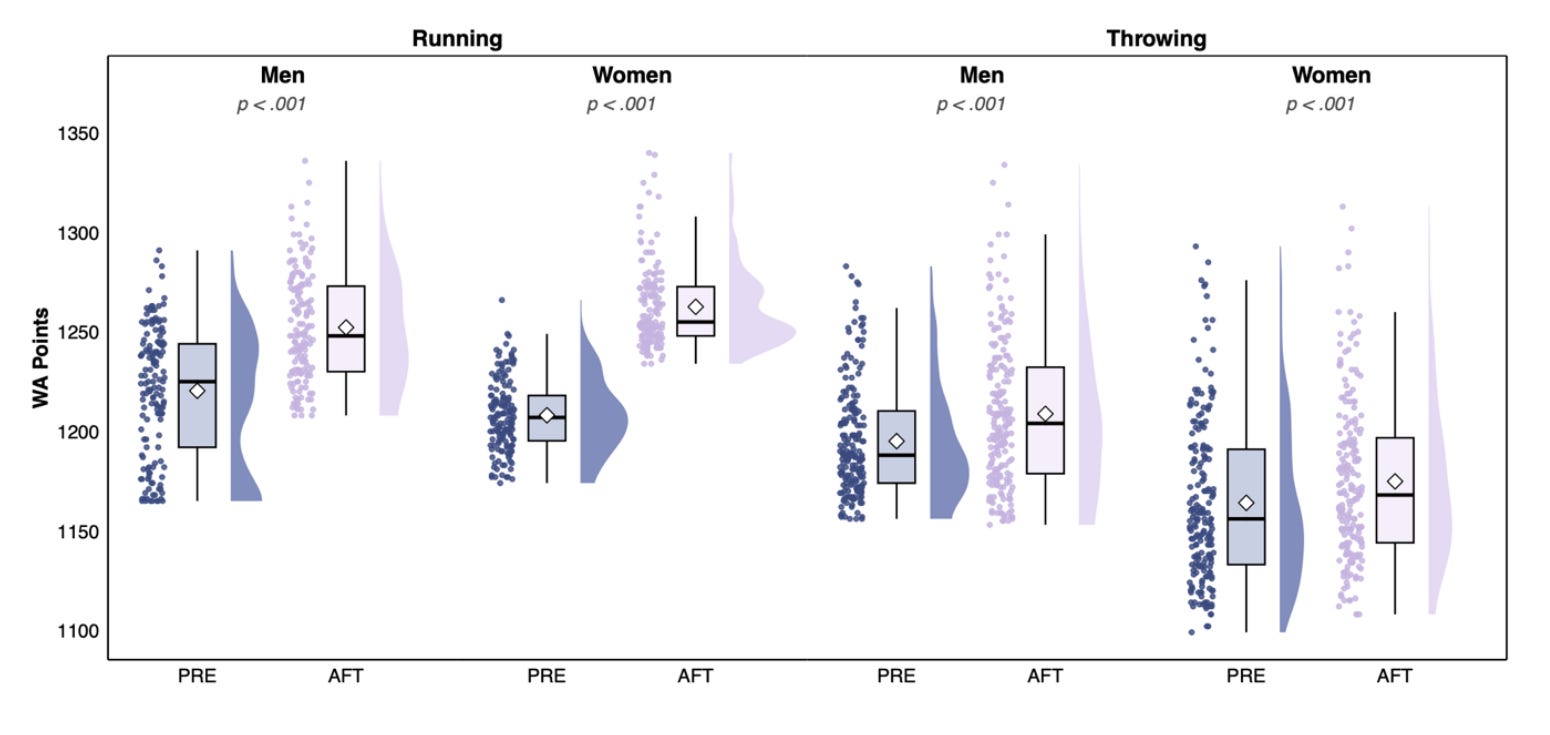
To compare very different events, the researchers converted performances into World Athletics points.
Road running improved much more than throwing after advanced footwear arrived.
Across the three road events, women’s performances improved by 4.51 percent, while men’s improved by 2.62 percent. Throwing improved by about 1 percent in both sexes: 0.93 percent in women and 1.14 percent in men.
Compared with the pre-supershoe era, women’s times improved by 3.52 percent in the 10K, 3.43 percent in the half marathon, and 3.04 percent in the marathon. The corresponding changes in men were 1.75 percent, 0.90 percent, and 1.13 percent.
In other words, the improvement associated with the new era was larger in running than throwing—and within running, it was larger in women than men.
The researchers also performed a wonderfully intuitive analysis: How many performances from the old era still survived in the current all-time top 50 at the end of 2025?
Among men, 8.9 percent of the pre-supershoe 10K performances, 10.7 percent of half-marathon performances, and 12 percent of marathon performances remained. Among women, the survival rates were 0 percent, 2 percent, and 2 percent. By contrast, half to more than 90 percent of the old-era throwing performances were still in the top 50, depending on the event and sex.
What this means for runners
For most of us, the practical message is not that women should expect a three- or four-percent personal best simply by changing shoes. These figures describe the evolution of the world’s best performances across eras, not the response of an individual runner.
Supershoe benefits are probably more individual—and more context-dependent—than a single average suggests. Sex may be one contributor, but body mass, speed, mechanics, fatigue, shoe geometry, and comfort all matter.
In any case. I think it should be clear that shoes are making a difference in the rapid performance leaps we are seeing around the sport.
Caffeine helps burn more fat
Caffeine is one of the most reliable performance aids in endurance sport, but athletes often talk about it as if it has a second superpower: unlocking fat stores and sparing carbohydrate.
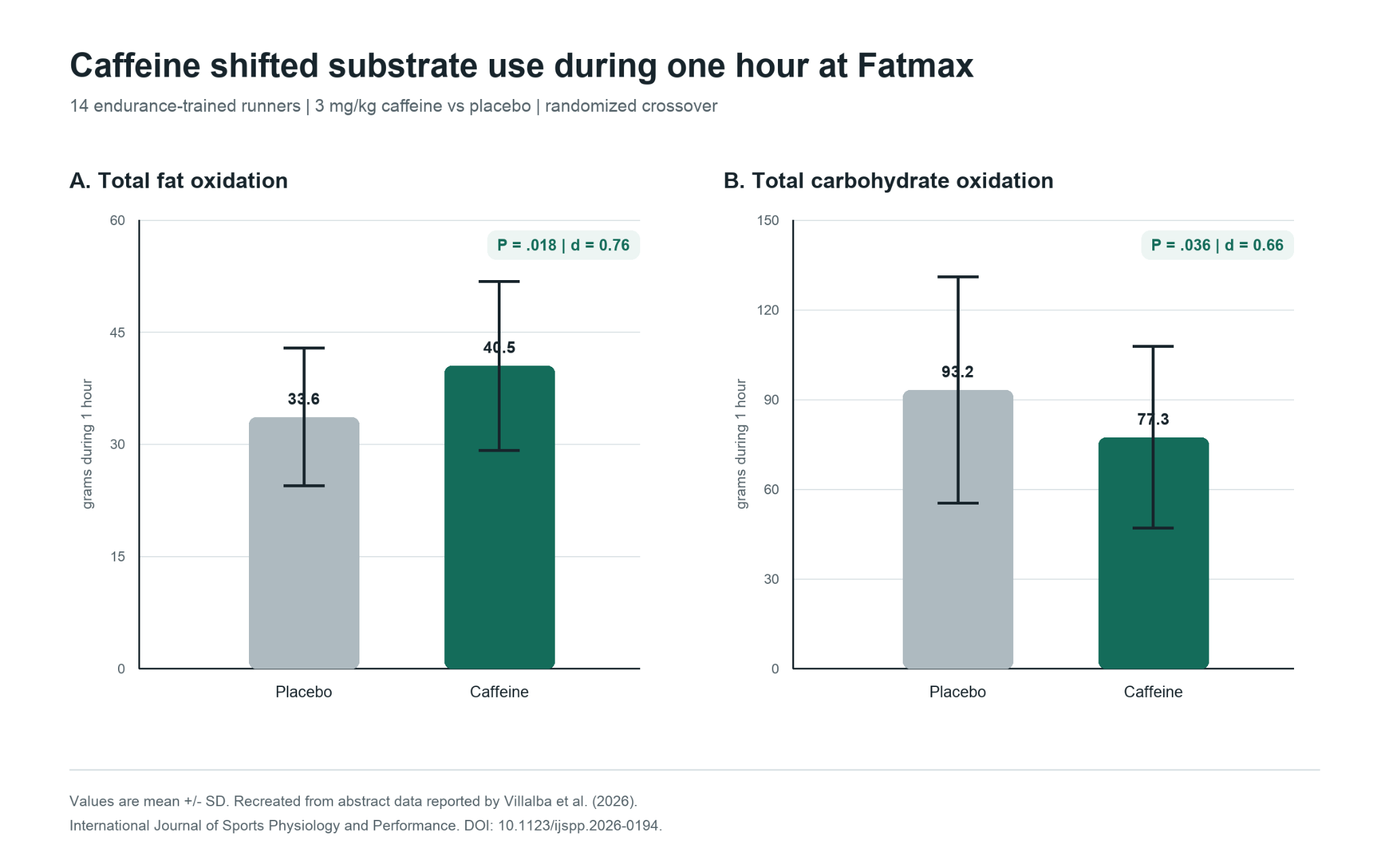
A randomized, double-blind crossover study tested that idea outside the lab. Fourteen trained runners—11 men and three women, with an average VO2max of 58.6 mL/kg/min—completed two one-hour outdoor runs at their individual Fatmax intensity (the pace at which fat oxidation had previously been measured to peak). Sixty minutes before each run, they consumed either 3 milligrams of caffeine per kilogram of body mass or a placebo before running laps while wearing a portable device that measured their fuel use during exercise.
With caffeine, the runners oxidized an average of 40.46 grams of fat during the hour, compared with 33.62 grams after placebo—a difference of about 6.8 grams, or roughly 20 percent.
Carbohydrate use moved in the opposite direction: 77.32 grams with caffeine versus 93.16 grams with placebo. Total energy expenditure did not change.
The runners also rated the effort slightly lower after caffeine, even though heart rate was not significantly different. This combination—more fat oxidation, less carbohydrate oxidation, and lower perceived effort at the same individualized intensity—suggests that caffeine changed both substrate selection and how the run felt.
What this means for runners
Caffeine can shift fuel use during a controlled, moderate-intensity run, but that does not make it a substitute for carbohydrates. If you tolerate caffeine and already use it for performance, this study adds a plausible metabolic effect to the better-established benefits for alertness and perceived effort.
The practical dose here was 3 mg/kg taken one hour before running—about 200–300 mg for your average-sized runner. That is a meaningful dose, and more is not automatically better. Test it in training, account for other caffeine you consume, and remember that sleep lost to an afternoon dose can erase any advantage you hoped to gain.
What happens to the body after 30,303 kilometers of running?
Most studies of ultra-endurance exercise last hours or days. This one followed a man who ran for 444 days.
The participant was a highly experienced 49-year-old runner who attempted an extraordinary challenge: 30,303 kilometers (18,830 miles) in roughly 15 months. He averaged 68.3 kilometers (42 miles) per day, took only four days off, and spent about nine hours moving each day at an average speed of 7.7 km/h (4.8 mph). Most of the route was flat asphalt.
Researchers collected blood, body-composition, ultrasound, strength, muscle-biopsy, organ-imaging, and gut-microbiome data before, during, immediately after, and for as long as 17 months into recovery.
He finished. His body mass fell only about three kilograms or six pounds, with most of the loss coming from fat. Hemoglobin, electrolytes, and testosterone remained relatively stable. Imaging found no major cardiac or organ issues, aside from small increases in his left-ventricular diameter and liver size. After the challenge, his body mass rebounded to above his starting weight.
But everything wasn’t so rosy.
He developed painful problems at more than 10 musculoskeletal sites. A tibial stress reaction became painful and swollen midway through the challenge, then eventually resolved even though he continued running. He also experienced bilateral IT-band bursitis, tendinopathy, a partial tendon tear, meniscal abnormalities, and thickening of the plantar fascia.
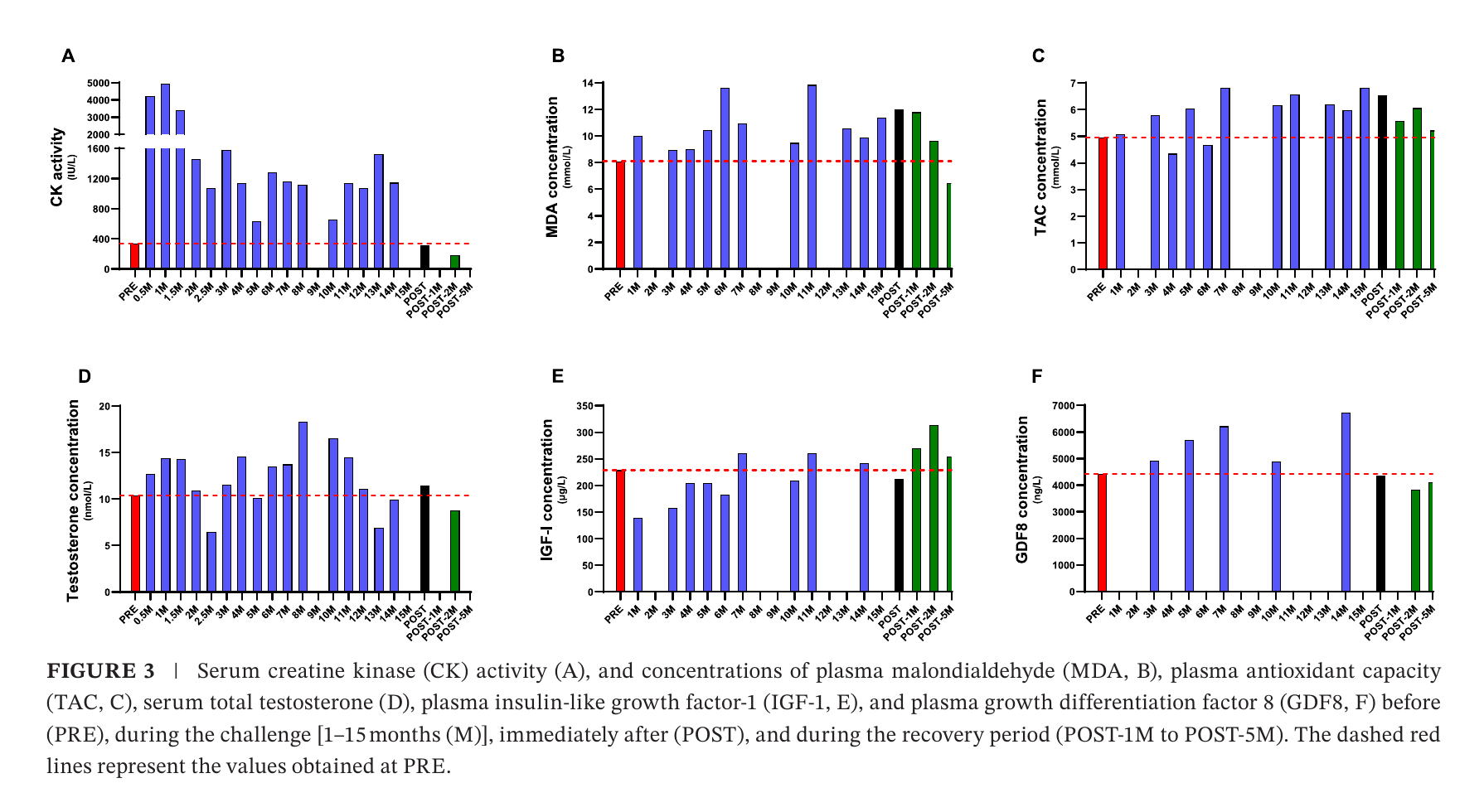
Muscle damage was persistent. Creatine kinase rose to about 15 times baseline during the first month and remained roughly three times baseline through much of the challenge. Markers of oxidative stress were elevated. Ferritin declined despite oral iron supplementation and two intravenous iron infusions, although he did not become anemic.
The performance losses were even more revealing. His jump height and power fell by roughly 35 to 50 percent, while his muscle’s ability to produce force declined about 25 percent. Strength recovered by 10 months, but explosive power and strength did not fully recover even 17 months later!
Muscle biopsies added a complicated picture. Markers involved in inflammation, apoptosis (a form of cell death), and autophagy declined during recovery, while proteins related to mitochondrial turnover and electron transport recovered or increased. Nearly all fibers remained slow-twitch type I fibers.
There were cognitive and psychological costs too. Between months 10 and 14, he reported episodes of forgetting his route and recent activities, as well as periods of reduced motivation and energy.
What this means for runners
Let’s be clear about what this was. This is a case report, not a general law of ultrarunning. Still, the case is valuable precisely because no conventional trial could ethically assign this exposure. It shows the difference between systemic resilience and local recovery. The heart, blood, and major organs can look surprisingly stable while muscle function, connective tissue, iron stores, and cognition carry a much longer debt.
This is not a training blueprint. It is an extreme demonstration that the ability to keep running does not prove that the body has absorbed the load. Pain can recede, blood work can look acceptable, and motivation can return before power and tissue function are restored.
High mileage is not automatically harmful, but unrelenting mileage without enough recovery can create costs that remain invisible until they are difficult to reverse.