Does Carb Loading Actually Work?
Plus, vitamin D and NSAIDs for ultra-running; hacking heat acclimation; hot water immersion as a recovery tool; and the mental health challenges of "multi-marathoning."


Does Carb Loading Work?
Few topics in endurance sports spark as much debate as carbohydrate loading. Ever since landmark studies in the 1960s showed that exhaustive exercise followed by a few days of high-carb eating could double muscle glycogen, athletes have treated “carb loading” like gospel before marathons. But the science has been a bit patchy: some studies confirm massive glycogen boosts while others show little change, and the differences between running and cycling protocols have muddied the waters.
A new systematic review and meta-analysis of 30 studies and 319 participants pulls together decades of research to finally answer the question: how much glycogen supercompensation really happens, and what factors influence it?
To be included, each study had to involve an exercise session that depleted glycogen, a subsequent 3–5 day high-carbohydrate diet, and direct measurements of glycogen.
The analysis separated cycling and running studies, recognizing that these sports stress muscles differently and may deplete glycogen to different degrees. The study also examined what variables (diet composition, baseline glycogen, VO₂max, etc.) predicted the degree of supercompensation.
On average, glycogen increased by ~270 mmol·kg⁻¹ dry weight (dw; this is a standard measure of the glycogen content in muscle) after cycling, versus ~157 mmol·kg⁻¹ after running. In practical terms, that’s a much bigger “fuel tank” boost for cyclists.
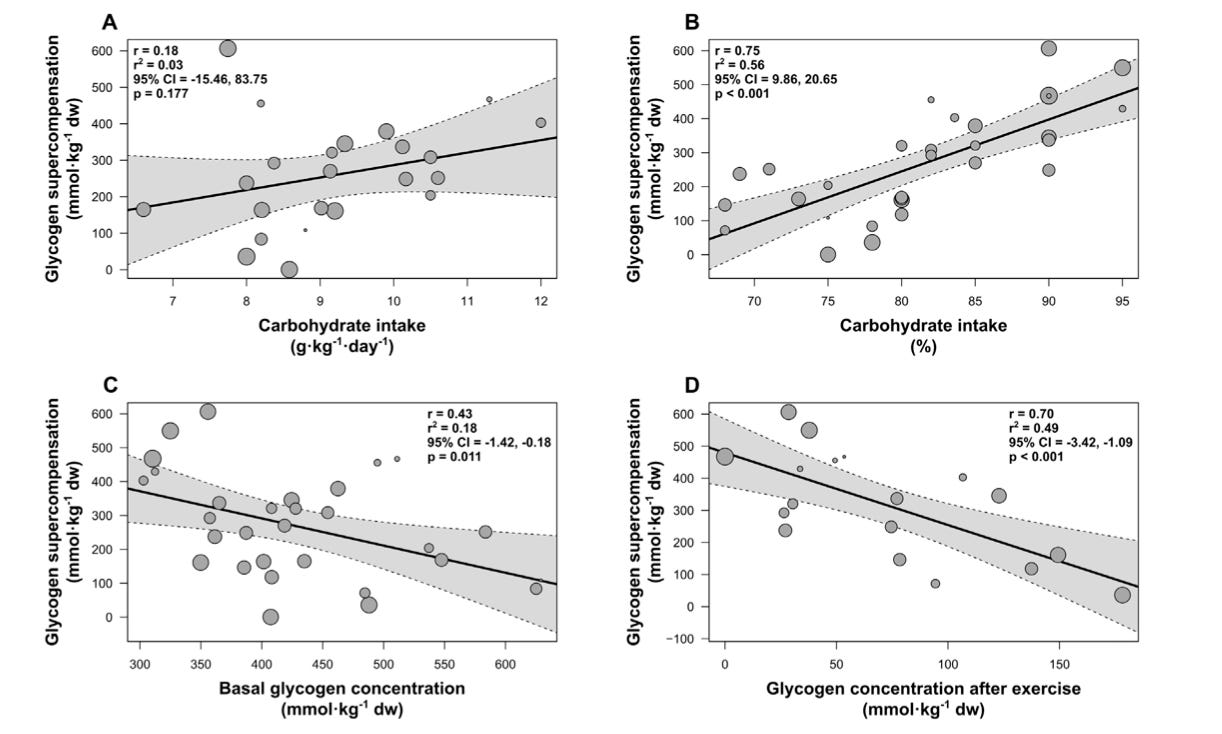
The higher the percentage of carbs in the diet, the greater the glycogen gain (no surprise there). Intakes above 8 g/kg/day were consistently effective. Absolute carb grams per day mattered less—once intake was “sufficient,” more didn’t add much. Lower baseline glycogen and lower post-exercise glycogen were both linked with larger supercompensation. In other words, the more you deplete, the more room there is to store during the “reload” phase.
Even with extreme loading, no study exceeded ~1,000 mmol·kg⁻¹ dw. Most athletes topped out around 700 mmol·kg⁻¹ dw, suggesting a ceiling on storage capacity. Men showed ~294 mmol·kg⁻¹ increases while women increased their stores by ~152 mmol·kg⁻¹, a finding that likely reflects lower energy intake in female participants in older studies, not a true physiological gap.
An interesting finding for running was also observed. Several running studies showed blunted or absent supercompensation. The authors suggest muscle damage from eccentric contractions may impair glycogen resynthesis.
What this means for runners
If you’re looking to carb load properly, maximize carb percentage in your diet, not just grams. A diet that’s 70–90% carbs for 2–3 days seems key. And make sure to go into your carb load depleted, because the biggest glycogen gains happen when you start low, so a glycogen-depleting workout paired with a slightly lower carbohydrate intake for a few days before loading may help. It’s not just about “eating more carbs,” but doing so strategically. Finally, it may be wise to avoid hard downhill running that could cause intense muscle damage, as this appears to reduce the effectiveness of carb loading to some degree.
Vitamin D Before an Ultramarathon Protects Runners’ Bones
Carbs and hydration (and maybe some caffeine) are typically front and center of any ultramarathon fueling strategy, but rarely do we think about bone health. Yet ultrarunning doesn’t just tax muscles and the cardiovascular system. The mechanical stress, long hours on the trails, and eccentric downhill pounding can disrupt bone metabolism and increase markers of bone breakdown. Maybe not incredibly concerning in the short term, but it does raise an interesting question: could something as simple as vitamin D supplementation protect our bones during extreme endurance events?
That’s what a new study set out to test.
Researchers recruited 40 semi-professional male ultramarathoners competing in a 240-kilometer mountain race in Poland. The runners were randomly assigned to receive either a massive single dose of vitamin D3 (150,000 IU dissolved in oil) or a placebo, taken 24 hours before the start.
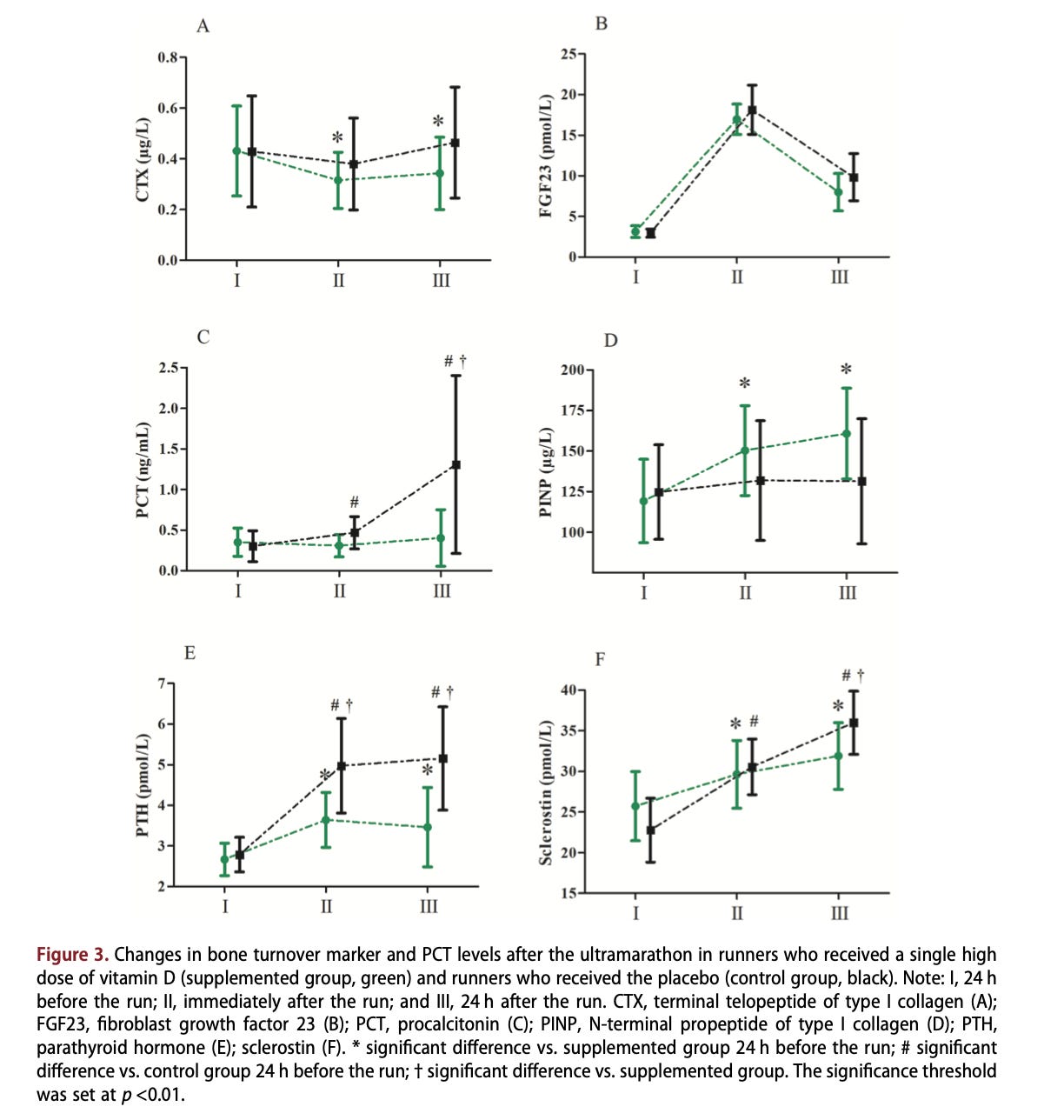
Blood samples were collected at three points: 24 hours before the race, immediately after, and 24 hours post-race to measure things like vitamin D levels, markers of bone health, hormones, and proteins linked to inflammation.
Not surprisingly, vitamin D levels skyrocketed in the supplemented group—serum vitamin D jumped by ~147% after the race compared with ~85% in the placebo group. CTX, a marker of bone breakdown, dropped in the vitamin D group immediately and 24 hours post-race, while the placebo group didn’t show meaningful changes. Sclerostin, a molecule that inhibits bone formation, also rose in both groups but was significantly higher in placebo runners. PINP, a marker of bone formation, rose significantly only in the supplemented runners.
All of this suggests that the single high dose of vitamin D helped tip the balance toward bone building.
Parathyroid hormone or PTH (which rises when calcium levels dip, driving bone resorption) increased less in the vitamin D group, and the pro-inflammatory procalcitonin spiked in the placebo runners but was curbed with vitamin D supplementation.
What this means for runners
Even though the study included only men who were all relatively seasoned runners, the findings suggest that vitamin D might act like a “bone shield” during extreme endurance events, reducing bone resorption and inflammation while promoting bone formation. One big pre-race dose worked here, but in practice, maintaining healthy vitamin D levels year-round through sunlight, diet, or supplementation is the more reliable strategy. Low vitamin D levels may leave you more vulnerable to bone stress and breakdown during heavy training or racing, so be sure to monitor levels somewhat regularly!
Can You “Trick” Your Body into Heat Acclimation Without Hot Weather?
Normally, heat acclimation means training in the heat or sitting in saunas or hot baths to simulate it. But what if you could get similar adaptations by simply wearing more clothes?
That’s the question this new study tackled—whether a structured overdressing protocol could mimic heat acclimation without requiring hot weather.
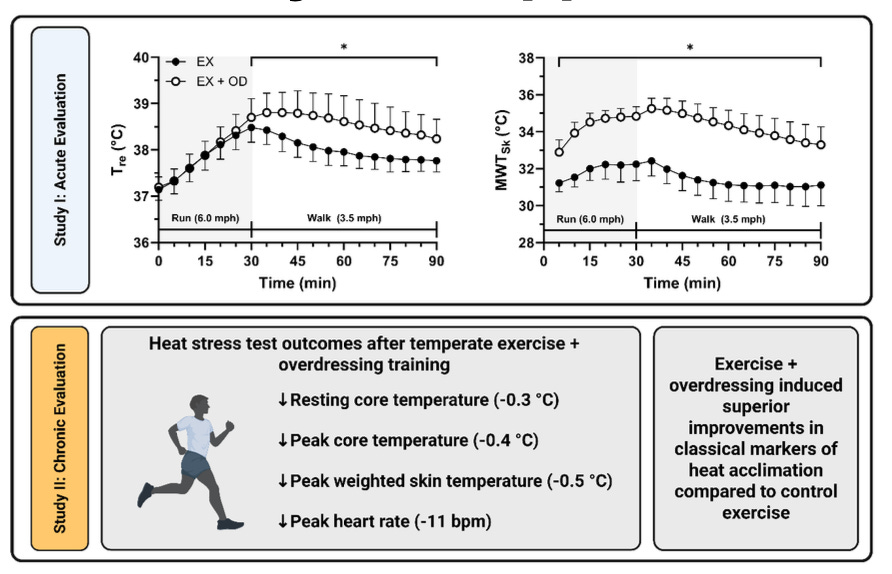
Researchers started by designing a protocol based on physics and physiology. Using manikin testing and heat-strain models, they determined that wearing multiple military clothing layers (t-shirt, shorts, combat uniform, rain layers, gloves, hat) while running at 6 mph for 30 minutes, then walking at 3.5 mph for 60 minutes, in a 20°C/68℉ gym environment, would raise core body temperature to ~38.5°C/101.3℉ and keep it there. That’s right in the sweet spot for heat acclimation.
They tested this in two phases:
Study I (acute trial): 22 fit volunteers (12 men, 10 women) did the overdressed protocol vs. a control session in shorts and a t-shirt. Just a one-time thing.
Study II (chronic trial): 12 participants completed five consecutive days of overdressing sessions, with heat stress tests (60 minutes of treadmill running in 40°C/104℉, 40% relative humidity) before and after the training period.
In the acute study, overdressing led to higher peak core temperature, skin temperature, heart rate (166 vs 147 bpm), and sweat loss compared to the control condition. Not surprisingly, participants also felt hotter and more uncomfortable.
After just five overdressed workouts, participants showed clear signs of heat acclimation. Resting core temperature dropped by 0.3°C, peak core temperature in the heat fell by 0.4°C, skin temperature by 0.5°C, and heart rate was lower by 11 bpm. None of these changes happened in the control group.
One performance caveat: Some participants couldn’t finish the full sessions, mostly due to fatigue or hitting the 39.5°C/103.1℉ safety cutoff. This shows the stress is real and not universally tolerable. Respect the heat!
What this means for runners
This study shows that you can, in fact, “hack” heat acclimation in cool conditions with structured overdressing. Five sessions were enough to induce many classical signs of heat acclimation. However, the protocols used here included tight medical oversight with cooling procedures ready. Trying this without safeguards like hydration checks, strict time caps, and rapid cooling could be dangerous. The researchers stressed that this isn’t a “free-for-all wear-a-sweat-suit” method. It needs structure and careful limits. If you want to try this at home, be conservative—don’t overlayer or push session duration beyond safe limits (and stay hydrated!)
Overdressing can work, and if you lack access to hot weather, a sauna, or a hot tub/bath, this alternative form of heat stress could add to your fitness this fall or winter. Even five sessions can produce measurable adaptations, so a week of overdressed training before a hot race may help.