Greetings, and welcome to the RLRH newsletter.
Thanks to ProBio Nutrition for sponsoring this post.
ProBio Nutrition is the daily all-in-one that’s been developed by Dr. Marc Bubbs, a nutrition expert and consultant to top athletes, and is formulated with a focus on performance, longevity, and recovery. I’ve been taking ProBio ProBlend for months, and my main takeaways are that this covers all your bases, like a multivitamin for people who train regularly, is a better value than an old supplement stack, and it actually truly tastes great.
RLRH has partnered with ProBio nutrition because we believe in the benefits, and our readers can get a flat 40% off using this link (oh, and if you subscribe you’ll get 50% off plus free shipping...)

Foam rolling might be useless
Foam rolling has become a runner ritual. You finish a hard session, flop on the living room floor, and start hunting for that “good pain” in your quads and calves like it’s a required step in the recovery recipe. Now add a vibrating roller—same idea, but with a buzzing motor that promises to melt soreness faster and get you back to training sooner. It sounds plausible. But does the data hold up to the hype?
A recent study put normal foam rolling, vibrating foam rolling, and basic static stretching head-to-head to see which is best for muscle recovery. The answer may surprise you.
The researchers recruited 18 experienced adult runners (ages 20–40; “experienced” meant they’d finished a half marathon) and used a crossover design, meaning each runner did all three recovery conditions on separate occasions:
Vibration rolling (VR)
Non-vibration rolling (NVR)
Static stretching (SS)
To reliably trigger delayed-onset muscle soreness (DOMS), participants first did a downhill treadmill running protocol designed to create eccentric muscle damage. Immediately after the run—importantly, before soreness really kicks in—the runners performed a standardized 20-minute recovery intervention targeting both legs: glutes, quads, hamstrings, and the front/back of the lower leg. In the VR condition, the roller vibrated at 28 Hz. Each muscle region got repeated short bouts (30 seconds per set, multiple sets), keeping the total time matched across conditions.
They assessed recovery at three time points: baseline, 24 hours, and 48 hours later.
And they looked at a mix of outcomes “inside the body” and those related to performance, including muscle damage and inflammation, flexibility, muscle stiffness, vertical jump performance, and balance.
Vibration rolling did not outperform regular rolling or static stretching on the outcomes runners actually care about—muscle damage signals, inflammation signals, or performance recovery—over the 48-hour window.
The downhill protocol did what it was supposed to do: it produced a DOMS-style response, most clearly shown by a muscle damage marker called creatine kinase (CK) rising at 24 hours, then starting to come back down by 48 hours.
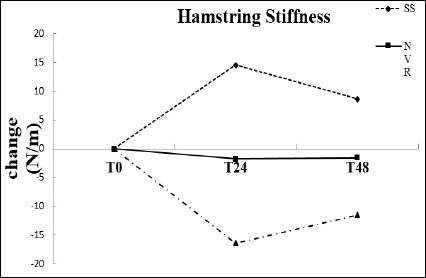
But when they compared recovery strategies, the patterns were basically the same. Inflammatory markers (CRP and IL-6) didn’t meaningfully change across time in a way that separated the interventions. Muscle stiffness didn’t show a clear improvement attributable to any one method. Jump height didn’t rebound faster with vibration rolling. Flexibility improved over time, and balance measures improved over time, but those improvements appeared to reflect the body’s natural recovery rather than anything special about vibration.
What this means for runners
If you love your vibrating roller, this study doesn’t give you a strong reason to throw it out—but it also doesn’t support the idea that vibration (or even foam rolling for that matter) is a recovery cheat code after a DOMS-inducing run. In the first 48 hours after downhill-style damage, vibration rolling looked a lot like regular rolling and even plain static stretching. You may feel better in the moment, but your muscle-damage and inflammation signals, plus basic performance markers like jump and balance, mostly follow their own timeline. For training decisions, I’d treat rolling (vibration or not) as an optional comfort tool—fine if it helps you relax and keeps you consistent. But put your real recovery budget into things like sleep and diet (we know those work!)
Is vitamin D a performance enhancer?
Vitamin D is one of those supplements that feels boring and mysterious. It’s boring because it’s not flashy, and it’s mysterious because people swear it changes everything from mood to muscle function, especially during the fall and winter months when the days get shorter, and most of our runs are happening before the sun comes up.
So, if you give runners vitamin D through the darkest months of the year, do you actually move the needle on anything that matters, like blood markers tied to immune health, and (more important to some) real performance?
A new study followed 45 healthy adults from October to March (a period with minimal sunlight exposure at their latitude). Participants were randomized into four groups:
Supplemented runners
Non-supplemented runners
Supplemented non-runners
Non-supplemented non-runners
The supplement was vitamin D₃ (2000 IU/day) delivered with a dissolvable strip and taken daily for 8 weeks. Then the researchers stopped supplementation and tracked everyone for another 12 weeks to see what happened as winter continued.
They measured serum 25(OH)D₃ (the standard vitamin D status marker) plus blood counts that reflect immune status. They also tested performance, including VO₂max (direct for runners; estimated for non-runners, countermovement jump (explosive power), and maximal isometric force (strength).
Runners had to be legitimately consistent: at least 3 years of endurance running, ≥3 runs/week, and a minimum weekly mileage of 30 miles/50 kilometers per week for men and 25 miles/40 kilometers per week for women.
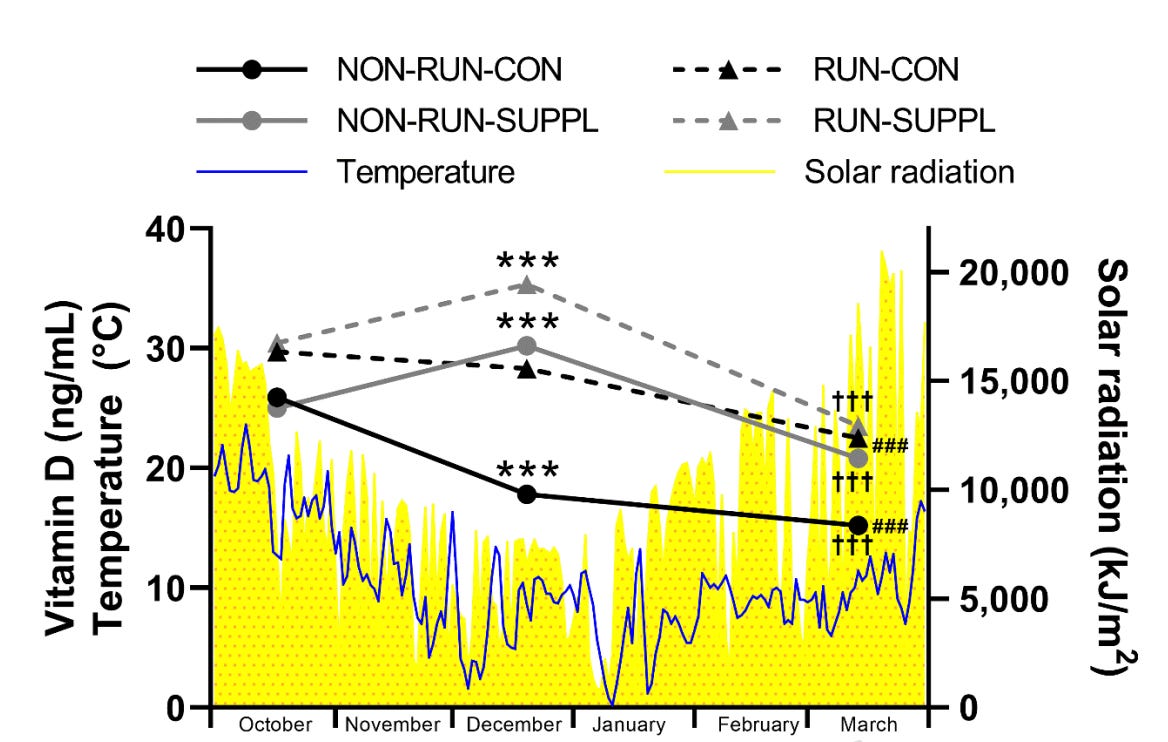
At baseline (mid-October), runners started a bit higher than non-runners. After 8 weeks:
Supplemented runners increased from 30.45 → 35.35 ng/mL (~21% increase).
Supplemented non-runners increased from 25.0 → 30.2 ng/mL (~29% increase).
Non-supplemented non-runners dropped from 25.93 → 17.8 ng/mL (~32% decrease).
Non-supplemented runners were relatively stable early on (about 29.7 → 28.3 ng/mL).
Once supplementation stopped, vitamin D fell across the board by March. Even the supplemented runner group dropped to ~23.5 ng/mL, and the non-supplemented groups ended up similarly low (or lower). So the supplement worked, but its benefits didn’t “stick” once they stopped.
Second, there was a noticeable immune signal, especially in the non-runners. Total leukocytes and neutrophils declined over the winter in the non-supplemented non-runners, while supplemented participants looked more stable.
Finally, vitamin D provided no real performance boost. VO₂max stayed essentially flat in runners (around ~60 mL/kg/min in both runner groups across all time points), countermovement jump didn’t change meaningfully, and strength showed only a hint of improvement.
What this means for runners
If you’re heading into fall/winter and your vitamin D tends to run low (or you live somewhere with minimal sun), this supports a simple strategy: 2000 IU/day (or potentially more) can keep your vitamin D status from sliding during the darkest months, and it might help maintain a steadier immune profile in the background… just don’t expect it to magically boost VO₂max. I’d treat vitamin D less like a performance supplement and more like a seasonal maintenance tool. It’s useful if your levels are trending down, especially if you’re injury-prone, frequently sick, or training hard through winter, but not something to bank on for faster workouts.
Does a marathon or a half-marathon stress the heart more?
Runners talk a lot about heart health, but less about cardiac fatigue, those short-lived, post-race changes in how the heart squeezes and fills. And when we do talk about it, the assumption is usually: the longer the race, the bigger the hit.
A new study set out to see if, in a real-world setting, recreational runners show different heart function changes after a half-marathon versus a marathon/ultra.
Researchers studied 105 recreational runners at the 2023 Silesia Marathon event, split into two groups:
Half-marathon: 49 runners
Marathon/ultramarathon: 56 runners
They performed echocardiography (heart ultrasound) and strain imaging (a sensitive way to detect subtle changes in heart muscle function) at three time points:
Baseline (1–4 days pre-race)
Immediately post-race
Follow-up (14 days later)
They also looked for predictors of who experiences a bigger dip (age, sex, body size, weekly training hours, etc.).
Most changes were mild, short-lived, and fully reversible within two weeks.
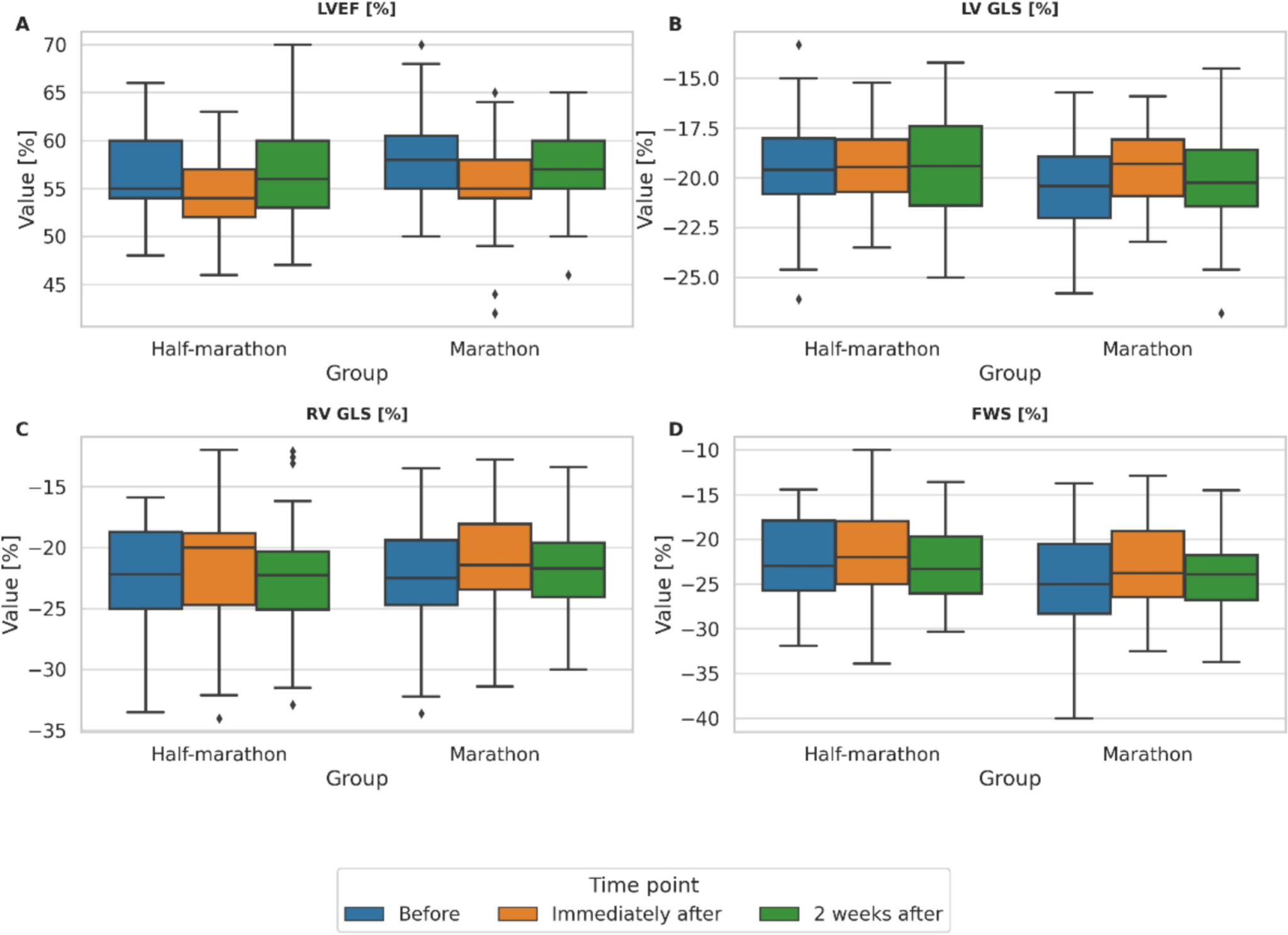
Left ventricle (main pump): Both groups saw a small post-race drop in left ventricular ejection fraction, but values stayed in the normal range and rebounded by follow-up. The half-marathon group went from about 56.6% to 54.5%, and the marathon/ultra group from 57.8% to 55.5% right after the race.
The more interesting signal showed up in a subtle contractility marker known as left ventricular global longitudinal strain. At baseline, marathon/ultra runners actually had slightly “better” strain (higher numbers) than half-marathoners. After racing, it dropped meaningfully in the marathon/ultra group (roughly 20.7 → 19.5), then trended back toward baseline at two weeks. The half-marathon group barely changed.
Right ventricle (often the canary in the coal mine for endurance racing): Right ventricle measures trended downward after the race in both groups, but the pattern was less consistent than the left ventricle. Right ventricle strain numbers declined a bit post-race, but by two weeks, the numbers largely normalized.
One simple right-ventricle function metric, known as TAPSE, also dipped after racing. The marathon/ultra group showed a larger absolute drop (about 24.6 → 21.6), but variability was high, and the authors didn’t find a clean, reliable reason to conclude that distance causes bigger right ventricle fatigue.
Atria (the heart’s smaller chambers): Atrial strain (both left and right) tended to drop right after the race—consistent with transient changes in filling pressures and the whole cardiovascular stress response. But like most measures, it also recovered by follow-up.
Does race distance matter? Surprisingly, not much. Even though the marathon/ultra group showed a clearer dip in left ventricle strain, the overall cardiac response pattern looked broadly similar between groups, and everything bounced back. So the race distance didn’t matter much. And the authors couldn’t reliably predict who would have more cardiac fatigue based on other factors. There were hints that higher weekly training volume might blunt the post-race dip, while older age might be associated with a slightly bigger hit to some markers. But these were just trends, not strong predictors.
What this means for runners
For most healthy recreational runners, a half-marathon, marathon, or even ultra can produce small, temporary “cardiac fatigue,” but this study supports the idea that it’s usually a normal, reversible response rather than damage. The actionable takeaway isn’t to fear long races but to respect the recovery window by giving yourself a few days to a couple of weeks of truly easy running after an all-out effort.