Is Carb-Loading Useless?
No, but it's not magic either.


In the final day or two before a marathon, we’re all given the same advice. Eat more carbohydrates, reduce training, top off glycogen, and arrive at the start line with the tank full.
It is one of the most familiar rituals in endurance sport, and the basic physiology behind this idea is solid. Muscle glycogen (think of it as stored carbohydrates) is a critical fuel source during prolonged moderate- to high-intensity exercise. When glycogen availability falls, the ability to sustain pace or power can suffer.
But how much of a performance boost does “carb-loading” really provide?
A new commentary in the International Journal of Sport Nutrition and Exercise Metabolism asked whether traditional carbohydrate loading provides an additional performance benefit once athletes are already fueling before and during the race in ways that reflect current practice.
This is an important distinction because much of the original carbohydrate-loading literature was built in an era when in-race fueling was far less developed than it is today. Many studies tested athletes after limited pre-exercise carbohydrate intake, with no carbohydrate provided during the exercise test. In that setting, it is not surprising that starting with more glycogen improves endurance capacity. But that is not the same scenario as a marathoner eating breakfast, taking gels every 25–35 minutes, and consuming a carbohydrate drink on course.
The paper does not argue that glycogen is unimportant, but it does challenge the certainty around one specific idea—that pushing muscle glycogen above normal through aggressive 24–48 hour carbohydrate loading reliably improves performance beyond what is achieved by adequate pre-race fueling and optimized carbohydrate intake during the event.
The authors reviewed the carbohydrate-loading literature with two methodological questions in mind.
First, were the studies double-blind and placebo-controlled? In other words, did participants and researchers actually not know whether the athlete was receiving the carbohydrate-loading intervention or the comparison condition? (This is important for reasons we’ll discuss later).
Second, did the studies provide carbohydrates during exercise in a way that resembles real-world endurance competition?
Both questions are important because performance is physiology filtered through perception, expectation, motivation, pacing, and belief. If an athlete knows they are carbohydrate-loaded, that knowledge may influence how hard they are willing to push, how they interpret fatigue, or how confident they feel late in a test. Likewise, if an athlete is asked to perform prolonged exercise without carbohydrate intake, the test may exaggerate the benefit of pre-exercise glycogen stores compared with a real race where carbohydrate is consumed throughout.
To evaluate this, the authors identified carbohydrate-loading studies that compared a moderate or “normal” carbohydrate intake (roughly 4–6 grams per kilogram per day) with a higher carbohydrate intake (above 7 grams per kilogram per day for at least 24 hours). The studies also had to include an endurance performance or work-capacity test lasting at least 90 minutes.
From an initial search of more than 10,000 studies, they narrowed the field to (just) 14 eligible studies.
That alone tells us something—carbohydrate loading is one of the most deeply embedded practices in endurance sport, yet the performance evidence base that directly tests it under relevant conditions is not especially large.
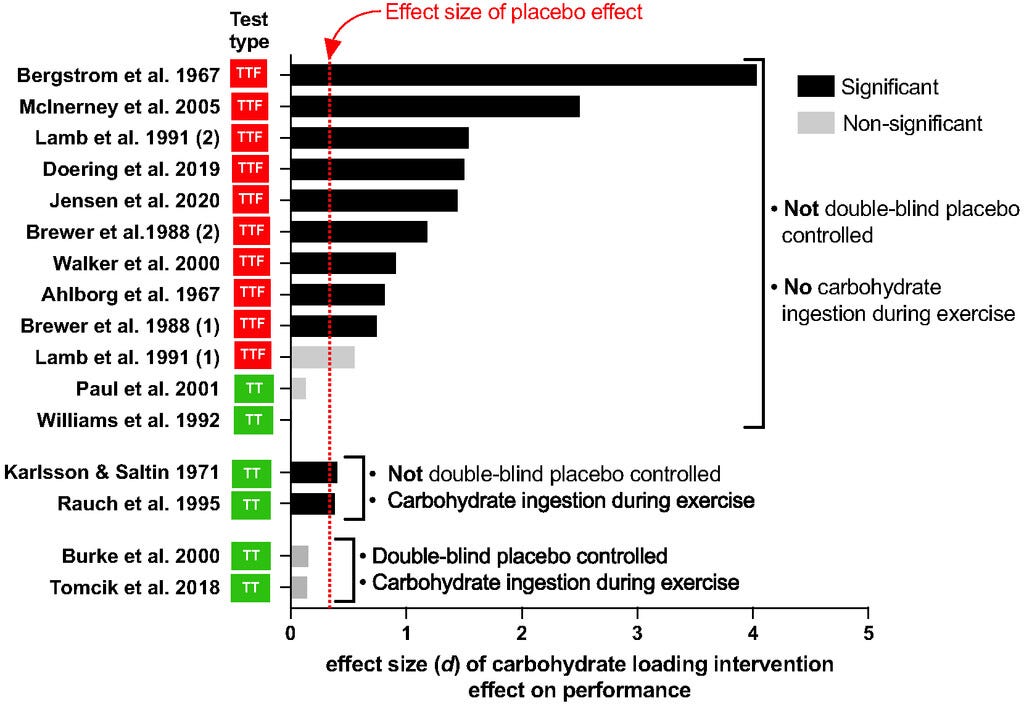
Of the 14 studies, only two used double-blind, placebo-controlled designs.
Only four provided carbohydrates during the performance test.
The two studies that did both—double-blinding plus in-exercise carbohydrate provision—did not show a clear performance benefit from carbohydrate loading.
Those two studies were small, with only 7 and 9 well-trained athletes, and only produced relatively modest increases in muscle glycogen: 18% in one study and 25% in the other. Classic carbohydrate-loading protocols can sometimes increase glycogen by 30–90%, so it is possible that these trials did not even create a large enough separation between “normal” and “loaded” conditions to fully test the question.
The largest benefits in the literature tended to come from studies that were not double-blind and did not provide carbohydrates during exercise. These studies often used time-to-exhaustion tests, where athletes continue at a fixed pace (or work output) until they can no longer maintain it. Time-to-exhaustion tests can be useful for investigating fatigue, but they do not fully mimic racing, where athletes pace themselves, respond to discomfort, and make constant decisions about effort.
This is where the interpretation gets a bit tricky. If carbohydrate loading improves your time to exhaustion in a fasted or underfueled test, that may demonstrate that glycogen availability matters; but it does not necessarily prove that aggressive carbohydrate loading adds a meaningful benefit for you arriving at the start line fed and consuming carbs during the race!
Even among the studies that did provide carbohydrate during exercise, the doses were typically around 60–70 grams per hour. That was consistent with older guidelines and still represents solid fueling, but it is below the 90–120 grams per hour now being discussed and used by some highly trained endurance athletes. So these studies still don’t fully reflect the highest end of modern fueling practice.