
This Supplement Could Help You Get More Out of Your Training
Are ketones the recovery tool we've been overlooking?


Several years ago, exogenous ketones were one of the buzziest supplements in endurance sports. These are the ketones you take as a “shot,” not the ones your body makes naturally when you fast or follow a ketogenic diet.
Around that time, I was also writing some blog articles for a company that was (and still is) one of the main players in the exogenous ketone space on the science of ketones, exercise performance, fasting, and cognition.
Most of the excitement centered on the question of whether ketones could improve endurance performance by acting as an alternative fuel source to carbohydrates.
And to be fair, it was not a crazy question.
But the more I’ve followed this research, the less interested I’ve become in ketones as a race-day fuel and the more interested I’ve become in ketones as a recovery and adaptation tool. Today you’ll see why.
First, what are ketones, and why should runners care about them?
Ketones are molecules your body can use for energy. The main one you’ll hear about in sports and metabolism research is beta-hydroxybutyrate, or BHB. Under normal conditions, your body makes ketones endogenously when carbohydrate availability is low, like during fasting, prolonged exercise, or a ketogenic diet. In that sense, ketones are a backup fuel, but they’re also much more than that. They act as signaling molecules too. That means they do not just provide energy, but also influence cellular processes related to inflammation, recovery, gene expression, and mitochondrial function. That’s where things get interesting from a performance perspective.
Exogenous ketones are ketones you consume rather than make yourself. They’re often taken as a concentrated “shot,” and they can elevate blood ketone levels quickly without requiring you to fast or follow a low-carb diet. You do not need to be keto-adapted to experiment with exogenous ketones. You can still eat carbohydrates, still train like a normal endurance athlete, and still use ketones strategically around exercise.
For a while, the main attraction was that ketones might serve as an extra fuel during long endurance sessions, maybe sparing glycogen or helping sustain output late in an event. Some early studies found modest benefits in time-to-exhaustion settings, and there were even stories of pro cycling teams ordering ketones during the Tour de France era of peak ketone hype.
That’s still part of the sales pitch today. And there are some genuinely interesting findings in newer work, including improved cognitive performance during ultra-endurance exercise.
But to me, the more compelling question now is not whether ketones help you run a bit faster during a workout; it’s whether they help you get more adaptation from the session after it’s over.
My interest really changed when the first chronic training study came out showing that ketone supplementation during a heavy endurance block reduced symptoms of overtraining in cyclists. I published a review article on that line of work more than seven years ago, and it changed how I thought about ketones entirely.
Instead of seeing them mainly as a fuel, I started seeing them as a post-exercise signal. A signal that might tell the body to recover faster, adapt more, and maybe not dig itself into such a deep hole during hard training.
That idea has only gotten more interesting with time, because a recent study suggests ketones may actually enhance endurance training adaptations themselves.
In other words, post-exercise ketones might help already fit athletes gain more aerobic fitness, more performance, and more mitochondrial remodeling during a training block.
This issue of the newsletter is brought to you by ProBio Nutrition—the all-in-one daily supplement for runners. Get 40% off with code RLRH (or 50% off + free shipping with a subscription) at ProBioNutrition.com

This study involved 28 trained male cyclists with an average VO₂peak of around 50–55 ml/kg/min. So these were not beginners, and they were not out-of-shape subjects getting easy gains from simply moving more. They were already fairly fit endurance athletes.
The intervention lasted 8 weeks and was structured into two 4-week blocks. Each block included 3 weeks of progressive training load followed by a 1-week taper with training load reduced by about 40–50%. The athletes trained 5 days per week, with 1–2 double-session days, and the program included a mix of steady aerobic work, high-intensity intervals, and all-out 30-second sprint efforts.
So while this was done in cyclists, the training structure should feel very familiar to runners. It looks a lot like a serious half-marathon, marathon, or even ultramarathon build, with a mix of aerobic volume, quality sessions, progressive load, and periodic deloading.
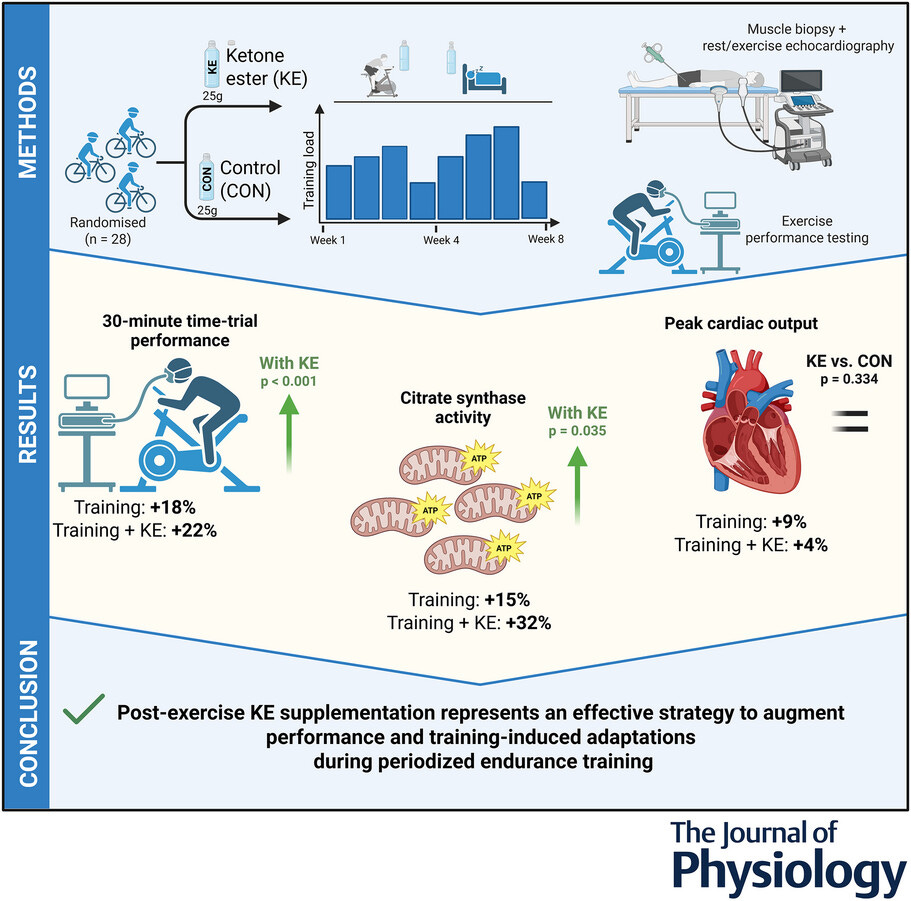
Here’s where the groups differed. After every training session and again 30 minutes before sleep on training days, one group consumed 25 grams of an exogenous ketone ester. That came out to 50 grams per day on training days. The control group consumed a taste-matched placebo.
Before training, after week 3, after week 7, and again after the final taper week, the athletes completed a 30-minute time trial and a VO₂max test. Researchers also looked at heart function, cardiac output, muscle mitochondrial markers, and subjective stress and recovery.
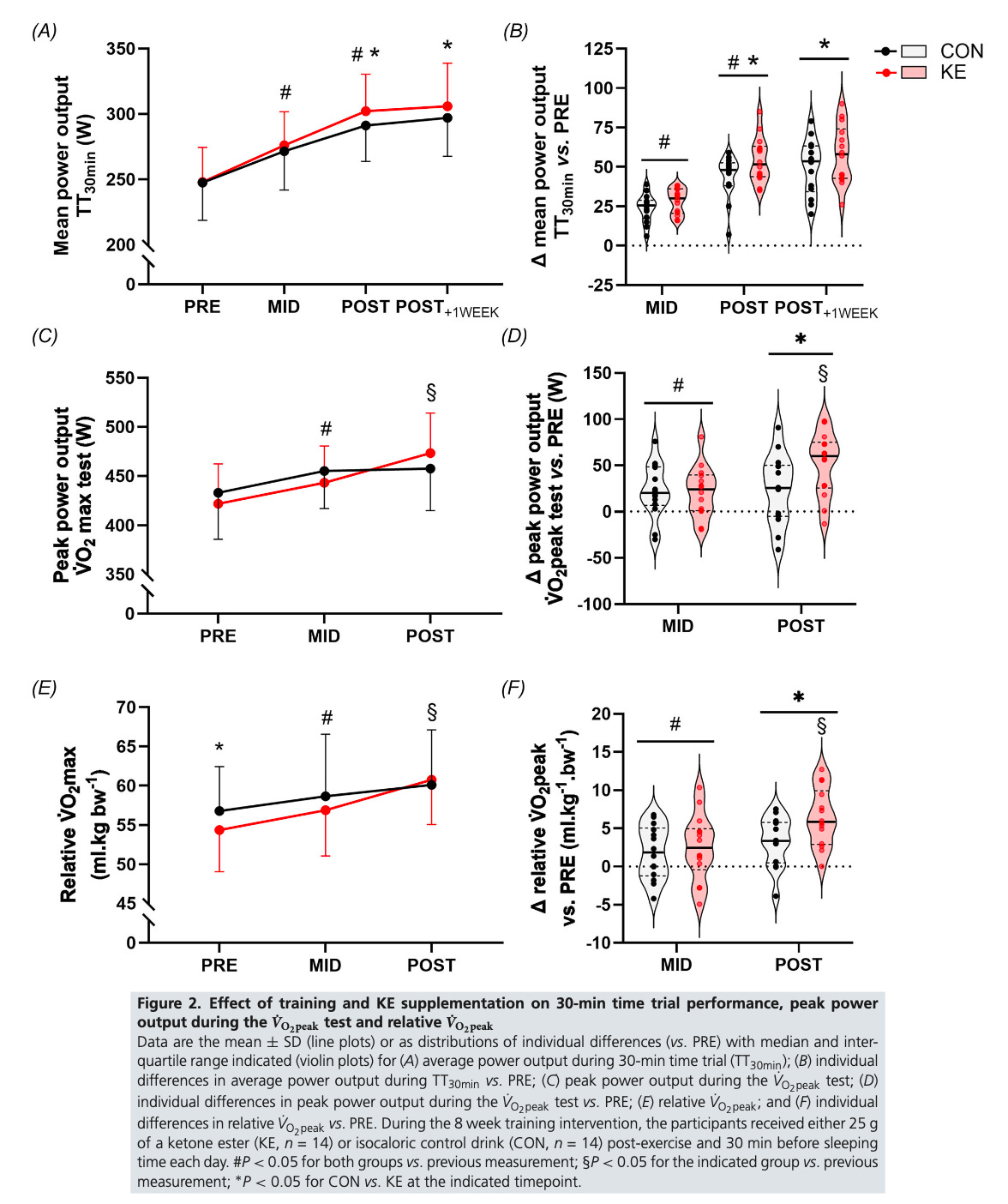
After 3 weeks of training, both groups improved their average power in the 30-minute time trial by about 10%. That makes sense. A structured block of training should improve performance.
But by week 7, the ketone group pulled ahead. Their average power output was about 4% higher than that of the control group, and that difference remained after the final taper week.
Peak power output followed a similar pattern. Both groups improved early, but from week 3 to week 7, only the ketone group continued to meaningfully improve. Over the full 8 weeks, the ketone group increased peak power by 52 watts, compared to 25 watts in the control group.
VO₂peak also improved more in the ketone group. Their increase was 6.4 ml/kg/min from pre- to post-training, compared with 3.3 ml/kg/min in the control group.
That alone would be enough to make endurance athletes pay attention. But the most interesting findings might be what was happening inside the muscle.
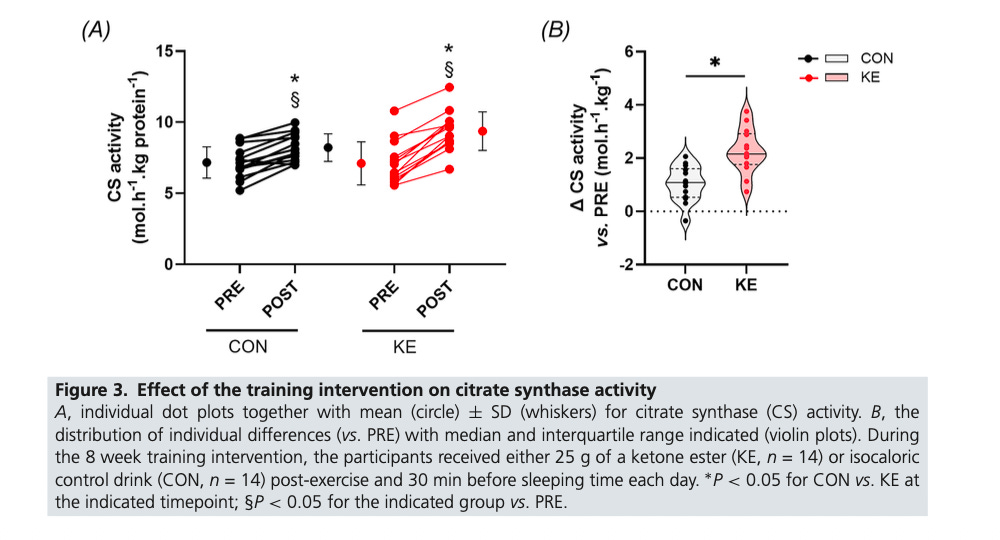
The ketone group had more than double the increase in citrate synthase activity, a commonly used marker of mitochondrial content. They also showed a 25% increase in the protein content of complex II of the electron transport chain (the energy-producing system within our mitochondria), while the control group showed no such change.
That points toward enhanced mitochondrial remodeling.
Mitochondria are central to endurance performance. They help determine how well you can produce energy aerobically, clear metabolic byproducts, sustain pace, and resist fatigue. For runners, that translates to the exact things we care about, including better durability, better aerobic efficiency, and better ability to hold pace deeper into training blocks and races.
Interestingly, the heart-related adaptations did not differ between groups. Both groups improved peak cardiac output and stroke volume. So the ketones do not appear to be enhancing the central cardiovascular side of adaptation. The advantage seems to be more peripheral, happening in the muscle.
That fits with the idea that ketones are acting like a signaling molecule that amplifies muscular adaptation to endurance training.
One thing I did find surprising is that ketones did not improve subjective stress and recovery scores. Both groups felt similarly beaten down over the course of the training period.
So this was not a case of the ketone group feeling amazing while the placebo group felt wrecked. Instead, the ketone group seemed to be adapting better, even though they did not necessarily feel better.
What this means for runners
For runners, the practical takeaway is not to start slamming ketones before every easy run and expecting free speed. The more interesting use case is after demanding sessions or during heavy blocks when you’re trying to maximize adaptation without endlessly increasing mileage. Think marathon builds, ultramarathon training, back-to-back long run weekends, or stretches where you are stacking workouts but cannot afford to add more volume. In that context, exogenous ketones may be an effective recovery-and-remodeling signal, potentially helping you build more mitochondrial fitness from the work you are already doing.
I still would not put them ahead of the basics like adequate fueling, carbohydrate availability, sleep, and smart training structure, but ketones may have a real place as a targeted tool when the goal is to absorb training better, not just survive it.
There are still important limitations here. This study was done in trained male cyclists, not runners, and not women. We also do not know how these effects scale in athletes who are less fit, more elite, or already doing everything else extremely well. And even if the mechanism is promising, ketones are not cheap, and many runners will choose to invest their “recovery budget” into something else.
Still, I think this study moves the conversation forward in a meaningful way.
For runners who care about adaptation, not just acute performance, post-exercise ketones may be one of the more interesting nutritional tools currently on the table, helping your body do more with the training you’ve already earned.
Thanks for reading. As always—Run Long, Run Healthy.
~Brady